


SLOW MOTION
South Africa, particularly the Western Cape, has the highest number of Testudines (formerly Chelonia) on Earth. We are one of the few countries that differentiate between tortoises, terrapins, and turtles.
Although you may find some cooling off in shallow water during intense heat, tortoises are terrestrial. Terrapins live predominantly in freshwater bodies but are often found migrating overland. Turtles are marine animals that live in the ocean and only come onto land to lay eggs.
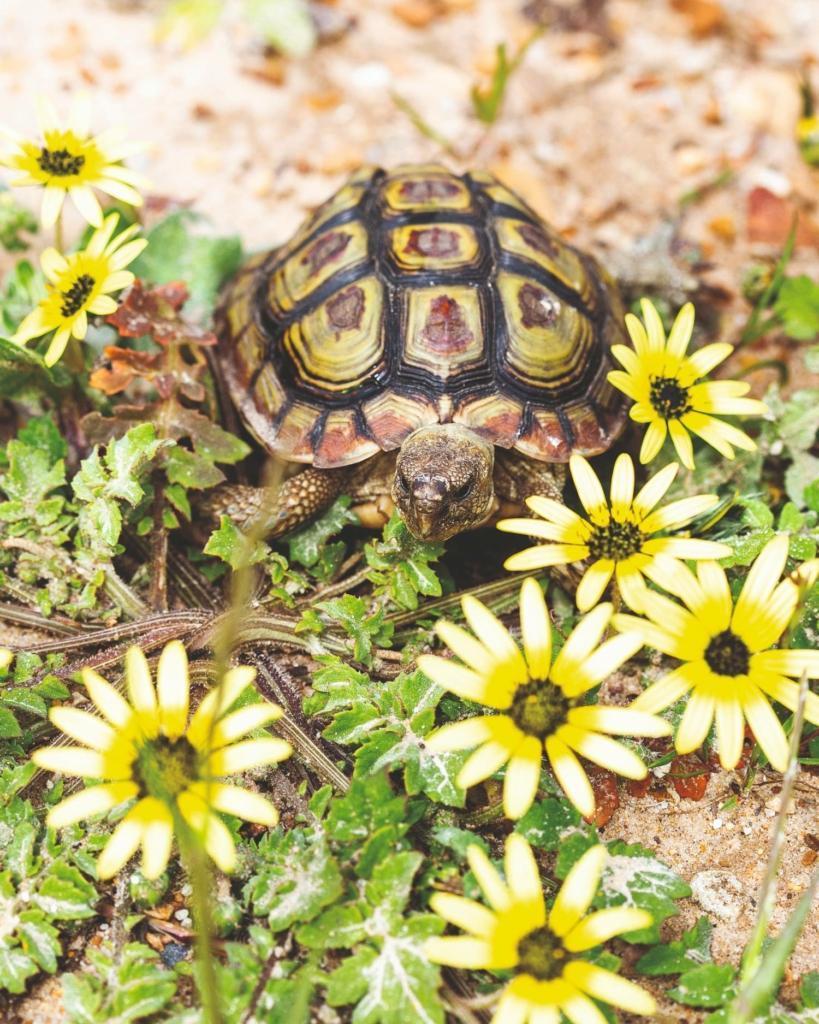
Of the 22 species of tortoise found in South Africa, Val de Vie Estate is home to two species. The angulate tortoise (Cheresina angulata) is easily recognisable by the triangles around the carapace, after which it is named. The shield under the head is extended in older males and is used for fighting rivals during the breeding season, which gives them the Afrikaans common name, ploegskaar skilpad.
Green parrot-beaked tortoises (Homopus areolatus) are small, even as adults and are rarely seen. These tortoises are endemic to South Africa. As their common name suggests, the carapace is a mottled olive green. Because of their stature, they tend to warm up slower than the larger species. They often move onto roads to regulate their body temperature, giving them their Afrikaans common name of gewone padlopertjie.
Tortoises do not make good pets as they require a seasonably varied diet. They don’t cuddle and are very boring when taken on a walk. Please don’t be tempted to pick one up ‘for the garden’ or, even worse, support the illegal trade in exotic pets by buying one from the roadside, as many species are threatened or endangered. Both the angulate tortoise and the green parrot-beaked tortoise are classified as protected wild animals in the Nature Conservation Ordinance No.19 (2000). Therefore, it is strictly illegal to remove this animal from the wild. It may not be transported, possessed, imported or exported without a permit.
Recently, 31 angulate tortoises from a local rehabilitation centre were released into the Val de Vie Estate biodiversity corridor and the fynbos reserve to reintroduce them onto the Estate.
INFO BOX
Did you know?
– A group of tortoises is called a ‘creep’.
– ‘Testudine’ means ‘resembling a tortoise shell’.
– Tortoises have an exoskeleton and an endoskeleton.
– Tortoises can’t swim but can hold their breath for a long time.
– They can smell with their throats.
– Tortoises can live up to 150 years.
– Nerve endings in their shells make them feel the slightest of touches.
– Tortoises don’t have teeth but sharp edges along their jaws.